
Employment Law
Wrongful Termination in India: Step-by-Step Action Plan
A sequenced playbook from day-of exit to notice, conciliation, and filing—built for employees who need calm procedure over panic.
See the wrongful termination workflow end-to-end · 3 min · plays inside LawGPT
When termination hits, people either freeze or spray emails in every direction. A better approach is a sequenced plan: preserve, calculate, demand, escalate. This step-by-step guide is India-focused and practical. Adjust timing if limitation or a new job offer forces acceleration, but try not to skip the artefacts each step should produce.
Step 1 — Stabilise access and evidence (Day 0–2)
Download payslips, tax documents, and policy PDFs while credentials work. Export key email threads. Write a private chronology the same evening: who said what, when you were asked to resign, what threats were made. Return company assets against acknowledgment. Do not sign settlement papers in the lobby without reading every clause, including hidden releases.
Step 2 — Classify your role and contract (Day 2–4)
Read the appointment letter’s termination clause. Note designation versus actual duties for workman analysis. Identify the state of your establishment and any standing orders. This classification decides whether labour conciliation, wage claims, or civil breach is your primary runway—and guessing wrong can cost months.
Step 3 — Build the dues sheet (Day 3–5)
Create a spreadsheet with unpaid salary, notice pay math, leave encashment, gratuity eligibility, and expenses. Separate “owed” from “ask.” Employers negotiate more readily when your floor is arithmetic rather than anger, and adjudicators respect itemisation.
Step 4 — Written HR demand (Day 5–7)
Before a formal advocate notice, a precise email requesting F&F breakup, termination reasons in writing, and relieving timelines is useful. It shows reasonableness. Set a short internal deadline and keep the tone professional even if the exit meeting was not.
Step 5 — Legal notice (Week 2)
Serve a formal notice with itemised demands and postal proof. Align every fact with your chronology. If you use LawGPT via /workflows/wrongful-termination, generate the draft from structured answers so later filings do not drift from your first story.
- Freeze evidence package and chronology
- Confirm legal employer entity name
- Draft notice, review, then serve
- Diary response deadline
- Evaluate reply or silence
- File labour pathway or settle with written terms
Step 6 — Settlement window (parallel)
Many cases resolve here. Negotiate money and documents together. Insist on payment dates and neutral wording. Avoid oral-only promises. If you settle, close the loop on any filed complaint properly so it does not linger as an open proceeding.
Step 7 — Labour Commissioner or appropriate forum
If needed in weeks three to six, file with annexures indexed. Attend conciliation. Track dates. Escalate only with the same fact spine you used in the notice. See the companion guide on the labour complaint process for deeper procedure notes by stage.
| Week | Focus | Exit artefact |
|---|---|---|
| 0 | Access and chronology | Evidence folder and timeline doc |
| 1 | Dues and HR demand | Spreadsheet and email record |
| 2 | Legal notice | Served PDF and tracking |
| 3–4 | Settlement or filing prep | Term sheet or complaint draft |
| 4–6 | Forum process | Diary of dates and orders |
Step 8 — Career track in parallel
Interview. Do not pause your life solely for a dispute. Just keep stories consistent with documents. Background verification is easier when relieving letter strategy was part of the settlement design rather than an afterthought.
Plan completion markers
- Day 0 chronology written
- Contract clauses extracted
- Dues sheet versioned
- Notice served with proof
- Forum chosen deliberately
- Settlement terms dual-control money and letters
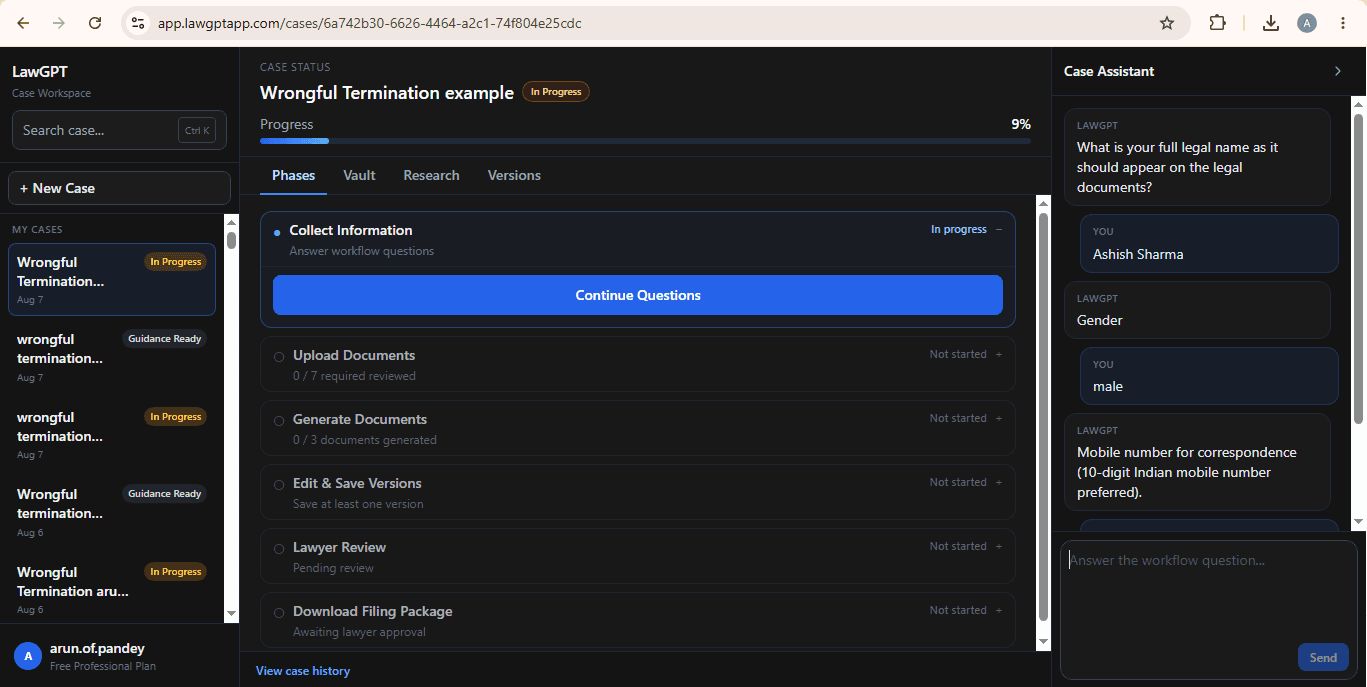
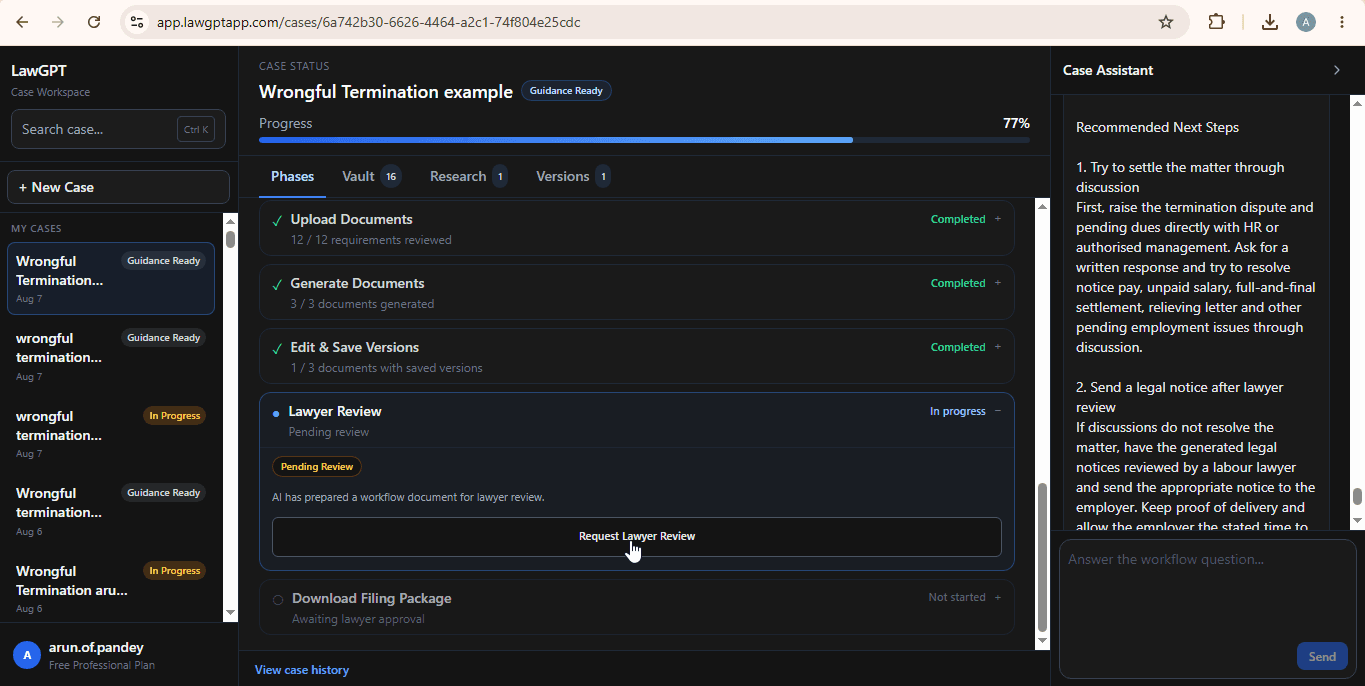
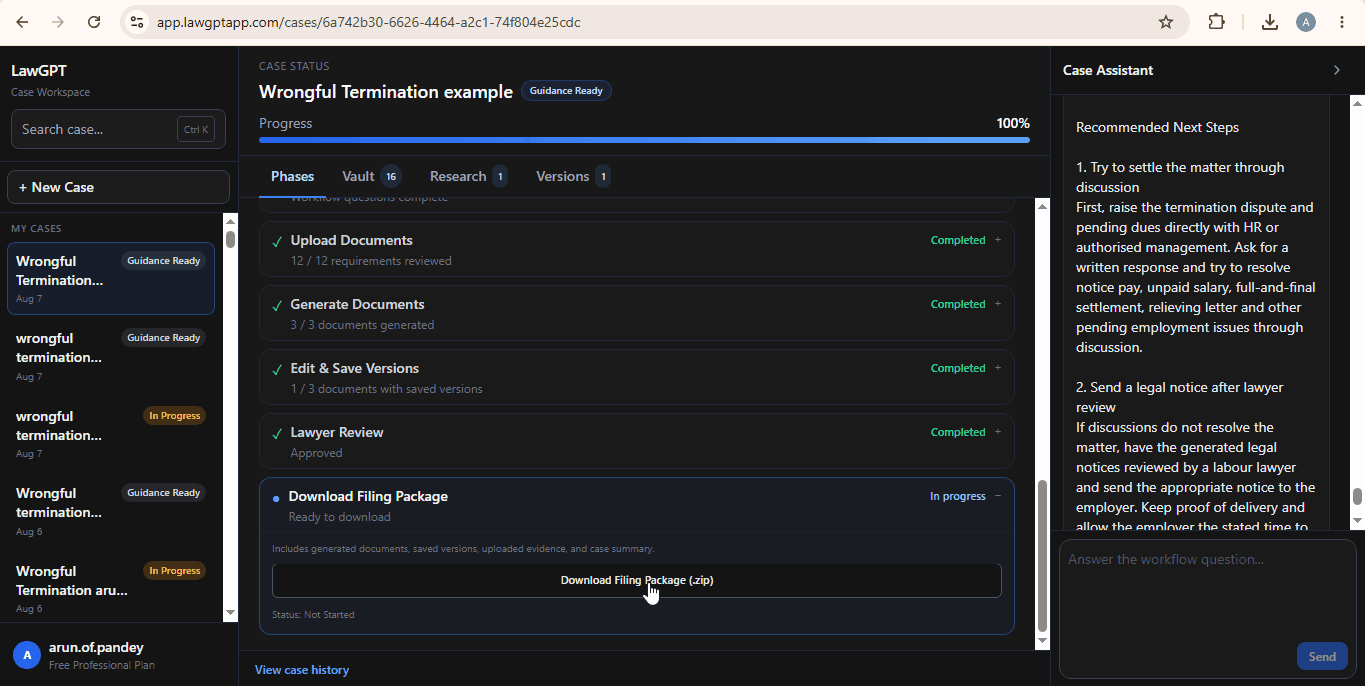
LawGPT’s productised workflow mirrors this sequence—guided questions, case summary, research context, document generation, optional lawyer review, download package—so you spend energy on decisions rather than formatting. Start from /workflows/wrongful-termination and explore /platform for the wider OS.
Decision gates: settle, file, or wait
A plan without decision gates becomes procrastination. After the HR demand, decide: is the employer engaging in good faith? After the notice deadline, decide: does the offer clear your floor? After the first conciliation, decide: is the gap bridgeable? Write the criteria in advance—“floor ₹X plus relieving within 7 days”—so a charming HR call cannot move your goalposts unconsciously.
Waiting is sometimes rational: a promised payment dated next Friday may be real. Waiting without a dated promise is how months disappear. Convert verbal promises into email confirmations the same day, then restart the clock.
Communications protocol for the entire plan
Use one primary email thread per topic where possible. CC a personal email if appropriate. Do not conduct substantive negotiations only on phone. After every call, send a summary: “As discussed, you will share F&F breakup by Thursday.” If they disagree, their correction becomes useful evidence. This protocol feels pedantic and wins cases.
Who to involve when
- Trusted mentor for emotional triage—not for legal strategy by rumour
- CA for tax on settlements above routine dues
- Advocate or LawGPT lawyer review when stigma or large quantum appears
- Family member to help diary dates if you are job-hunting hard
Too many advisers create contradictory instructions. Appoint one legal strategy owner—even if that owner is you with structured tools—and let others support.
Parallel job search without sabotaging the claim
Accepting a new job is usually wise. Just keep documents. Do not sign a new employer’s forms claiming you are still employed elsewhere. Do not badmouth the former employer in ways that create fresh disputes. If joining requires relieving by a date, escalate documentation demands early in the plan rather than at midnight before joining.
Run the sequence inside /workflows/wrongful-termination so each step leaves a downloadable artefact. That is the operational meaning of an AI OS for legal services on /platform: not magic outcomes, but fewer dropped steps when your attention is split between interviews and notices.
Templates for the three key emails
Email one (day 1–2): request written termination reasons, F&F breakup, and relieving timeline; attach asset handover acknowledgment. Email two (day 5–7): itemise dues politely and set a date for resolution. Email three (post-notice): if talks reopen, confirm meeting outcomes in writing within hours. These three emails, plus the formal notice, form a spine most employers’ counsel respect because it looks like a file, not a mood.
Avoid CC storms. Do not add the CEO, clients, and every HR intern on day one. Escalate addresses deliberately: HRBP, then HR head/legal, then formal notice to registered office. Scattershot CCs feel like pressure and reduce the chance of a calm commercial fix.
Metric for “plan health”
Green: evidence folder complete, dues sheet versioned, notice served or settlement signed. Yellow: waiting on a dated written promise inside your deadline. Red: more than seven days of pure verbal assurances, missing annexures, or contradiction between your resignation mail and your claim narrative. If you are in red, pause job-tweet energy and fix the file—LawGPT’s workflow checklist at /workflows/wrongful-termination is built for returning to green.
Week-by-week risks to watch
Week 0 risk: signing lobby papers. Week 1 risk: losing portal evidence. Week 2 risk: serving a factually wrong notice. Week 3 risk: accepting oral settlement without dates. Week 4+ risk: missing conciliation dates. Write these risks on a sticky note. Each week, ask which risk is live. This boring habit prevents the dramatic failures that make strong claims look weak.
If a new job offer arrives mid-plan, run a mini fork: accelerate documentation demands, avoid broad waivers just to join, and keep pursuing unpaid dues after joining if needed. Joining a new employer does not require abandoning lawful claims; it requires cleaner time management and truthful background-verification answers.
Closing the plan cleanly
A plan closes when money clears, letters issue, and any filed complaint is withdrawn or disposed on consented terms—or when an order is under compliance or appeal. Do not leave ghost proceedings open. Do not leave unsigned settlement drafts floating. Archive the final package beside your LawGPT download set so future you can find what happened without reconstructing from memory.
Tools and habits that keep the plan alive
Use a single cloud folder, a single chronology document, and a single dues spreadsheet. Put hearing dates in a calendar with alarms. After every call, send a confirmatory email. After every payment promise, ask for a date. After every document received, rename and index it the same day. These habits are mundane and decisive. Software like LawGPT encodes many of them into a workflow; your job is not to skip the habits because a draft looks polished.
Inside the LawGPT workflow
Frequently asked questions
Compress evidence preservation and send at least a written dues and documents request immediately. You can still pursue claims after joining, but do not sign broad waivers without reading.