
Consumer Law
Consumer Complaint Timeline: What to Do and When
A practical week-by-week timeline from the day a product or service fails to notice, filing, mediation, and order follow-through in India.
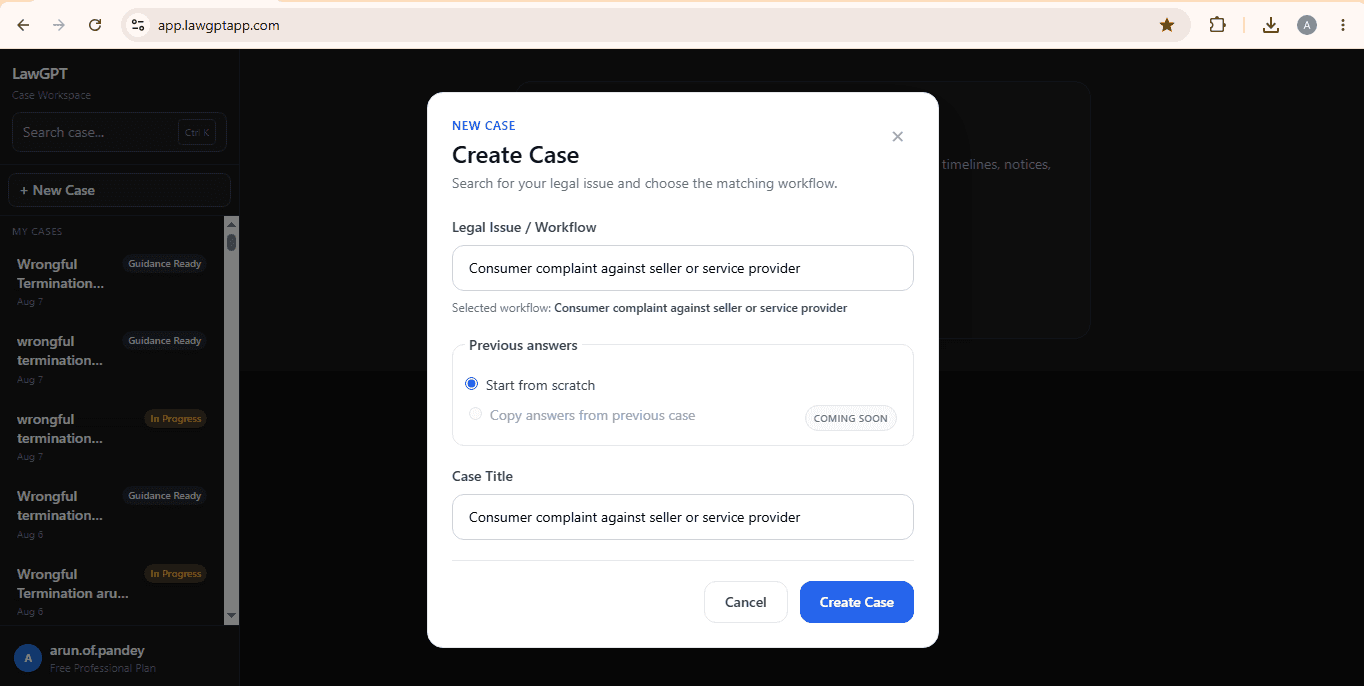
Consumer disputes reward early organisation. Waiting months for a chatbot to “look into it” is how return windows close and sellers vanish. This timeline is a practical default for India—compress it for perishable claims or approaching limitation, stretch the settlement window if a written offer is truly imminent.
Day 0–2: Evidence freeze
Photograph defects, export chats, download invoices, and record tracking pages. If safety is involved, stop using the product and document why. Open a folder structure immediately so you do not rely on memory next month.
Day 2–7: Seller and platform escalation
File in-app tickets, email grievance contacts, and ask for written timelines. For defective goods, book authorised service if required. For refunds, demand UTR-level specificity. Keep tone short and factual.
| Window | Focus | Done means |
|---|---|---|
| Day 0–2 | Evidence freeze | Folder + chronology started |
| Day 2–7 | Internal escalation | Ticket IDs + written asks |
| Week 2 | Legal notice | Served PDF + tracking |
| Week 3–4 | Evaluate reply | Credit received or file decision |
| Week 4–6 | Commission filing | Complaint number / acknowledgment |
| Ongoing | Hearings / mediation | Diary + settlement band |
Week 2: Legal notice
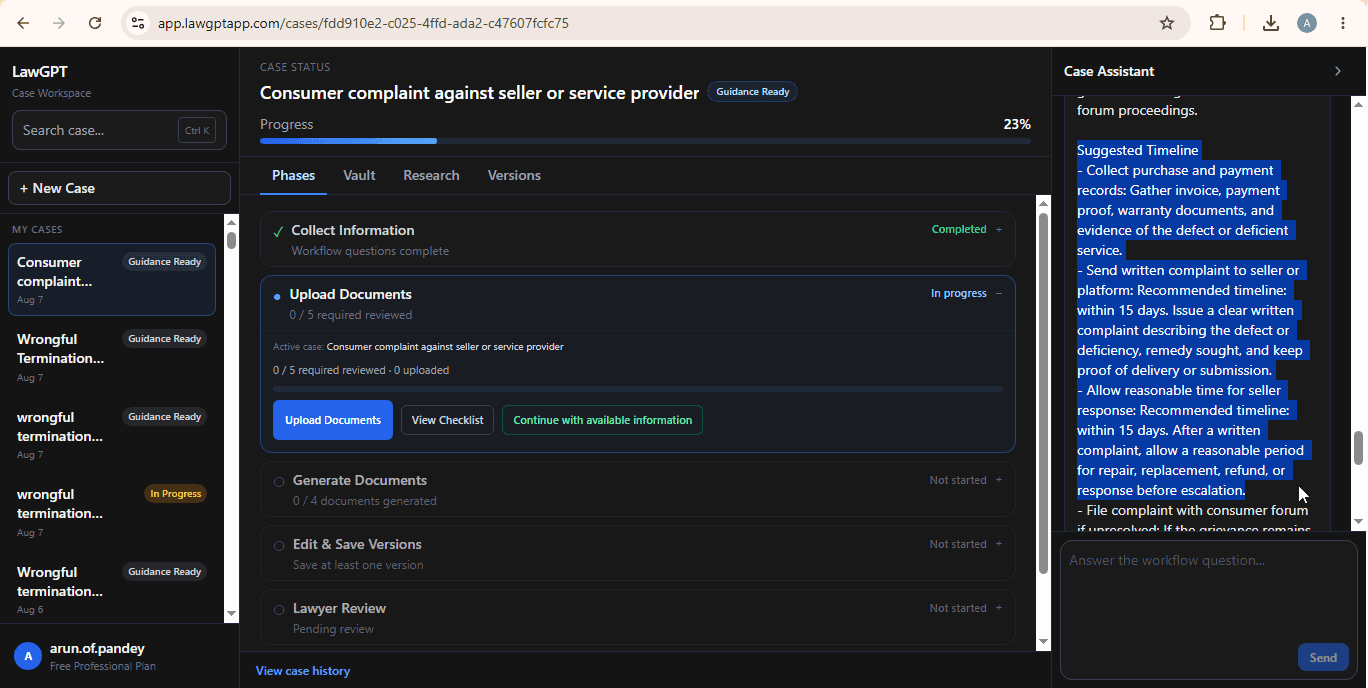
If internal escalation stalls, serve a legal notice with a clear deadline—often 7 to 15 days. Align facts with your chronology. Name the entities that invoiced you and controlled refunds. This is also when chargeback windows for cards should be consciously evaluated in parallel.
Week 3–4: Decision gate
Credit received? Verify amount and close politely in writing. Partial offer? Negotiate consciously. Silence or denial? Prepare the consumer commission complaint. Do not reopen endless chat loops that produce no new artefacts.
Week 4–6: File if needed
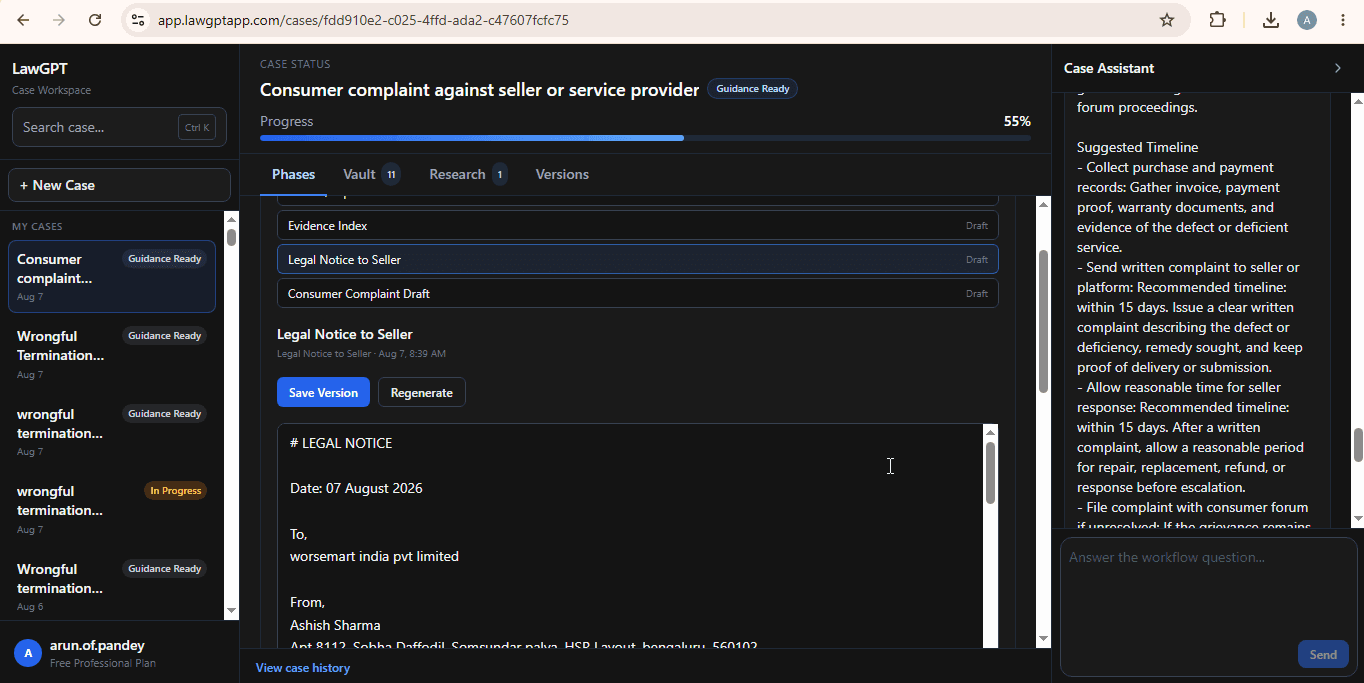
Choose tier, finalise parties, index annexures, and file. Mediation may appear early—bring your settlement floor. If you use LawGPT via /workflows/consumer-complaint, generate aligned drafts during week two and three so filing is not a fresh writing project under stress.
Timeline discipline checklist
- Calendar the notice deadline the day you serve
- Calendar return windows and warranty end dates
- Calendar payment chargeback windows if applicable
- Set a personal “file by” date
- After filing, diary every next date the same evening
- Review settlement band before each mediation slot
After the order
Build a mini-timeline for compliance: when refund should hit, when replacement should ship, when you will execute for non-compliance. Explore /platform if you need structured follow-through tools beyond the initial complaint package.
A timeline does not make the opposite party honest. It makes you difficult to stall—and that is often enough to unlock refunds that “could not be processed” for weeks.
Fast-track scenarios that compress the calendar
Compress the default timeline when: the seller is deleting listings, a wedding or travel date makes delayed performance useless, a safety defect risks harm, limitation is close, or a chargeback window is about to expire. Compression means same-day evidence freeze, 48-hour grievance email, and notice within a week—not skipping proof. Speed without papers just produces a fast weak case.
Tell the opposite party why time is of the essence in one factual sentence. Urgency explained beats urgency performed as shouting.
Slow-burn scenarios where patience is strategic
If an authorised service centre has already scheduled a meaningful repair with parts arriving on a dated challan, a short controlled wait can be rational. Control it with a written outer deadline: “If not cured by [date], I will seek refund.” Patience without an outer deadline is how repair loops become lifestyles.
Calendar template you can copy
- T+0: evidence freeze complete
- T+3: grievance email sent
- T+10: legal notice served if unresolved
- T+25: file-or-settle decision
- T+30 to T+45: commission filing target if needed
- Every hearing: next-date entered in phone calendar with alarms
Put these dates in your phone the day the dispute starts. Motivation fades; alarms do not.
Post-filing timeline management
After filing, the timeline shifts to institutional speed. Your personal KPIs become: no missed dates, rapid defect cures, settlement band readiness, and evidence completeness. If mediation is scheduled, prepare the night before, not in the autorickshaw. If an order issues, create a compliance timeline within 24 hours.
Align drafting weeks with /workflows/consumer-complaint so week two produces a real notice artefact. Use /platform when multiple deadlines—warranty, chargeback, limitation—collide and you need a reviewed priority order.
Limitation-aware planning
Consumer claims are subject to limitation rules that can extinguish remedies if you sleep on them. Do not confuse an open support ticket with a legal pause. If your dispute is already months old, accelerate: freeze evidence today, send notice this week, and target filing promptly after the deadline. When calculating delay, write down the date of cause of action as you understand it—delivery date, refund due date, or final refusal—and seek advice if you are near a boundary.
Also diary warranty end dates and return windows separately from legal limitation. A return window can close even when a legal claim survives—and vice versa. Multiple clocks can run on the same order.
Family and caregiver purchases
If you are escalating for a parent who received a defective medical device or a student who paid coaching fees, gather authorisations and relationship facts early. Timeline discipline includes deciding who attends hearings and who holds originals. A clear ownership map prevents “I thought you filed” gaps that cost months.
Integrating warranty, chargeback, and commission clocks
Draw three lines on a page labelled Warranty or Return, Payment Dispute, and Consumer Claim. Put hard dates on each. Work backwards from the earliest hard date. That single sketch prevents the classic error of fighting inside a warranty desk until every other clock dies. Share the sketch with anyone helping you so well-meaning relatives do not say “just wait another month” at the wrong time.
If a festival sale purchase creates a dispute, expect slower seller responses and plan earlier escalation. Marketplace warehouses overload; your calendar should not.
After settlement: verification week
When a refund promise is made, verify credit within the promised window, confirm no residual ticket traps, and only then withdraw complaints as agreed. Build a verification week into the timeline. Premature withdrawal is how “settled” cases resurrect as unpaid. Keep the verification artefacts beside your LawGPT package for at least a few months.
Sample dated playbook for a failed online refund
Day 0: export chats and invoice. Day 1: in-app ticket. Day 4: grievance email with deadline. Day 11: legal notice if silent. Day 20: evaluate reply. Day 25: file consumer complaint if unpaid. Day 25+: mediation readiness with floor set. This playbook is not sacred—it is a default. Adjust when chargeback deadlines or travel dates intervene. The point is to replace vibes with dates. Put the playbook in your calendar the afternoon the dispute begins, and let /workflows/consumer-complaint produce the artefacts at each gate.
Timeline for a defective appliance with warranty loops
Day 0–2: photograph defect and serial; open brand service ticket. Day 3–10: attend service visit; collect job sheet. Day 11–20: if unresolved, written demand for replacement or refund with a deadline. Day 21: legal notice if ignored. Day 30–40: consumer commission filing while warranty ticket remains referenced as diligence. The point is parallelism: warranty process runs, legal clock also runs. Waiting for the warranty desk to declare defeat forever is how timelines die. Put both tracks in one calendar shared with whoever helps you escalate.
If parts are “expected in three weeks,” ask for the part code and a written ETA. Convert every soft ETA into a hard personal decision date. On that date, either extend once in writing or escalate. Infinite soft ETAs are not a timeline; they are a stall pattern.
Build buffer days before hard deadlines. If a chargeback window ends on the 30th, escalate on the 20th, not the 29th. Buffers absorb courier delays, portal outages, and family emergencies. Timelines without buffers look neat on paper and fail in real life.
Share your dated playbook with one accountability partner who will ask each Sunday whether the next gate was hit. Solo disputants drift. A weekly check-in restores the timeline without requiring a lawyer on retainer. If a gate was missed, reschedule deliberately rather than pretending the old date still governs.
A timeline you actually follow is more valuable than a perfect timeline you ignore—start today, adjust tomorrow, and keep the artefacts moving.
Inside the LawGPT workflow
Frequently asked questions
Highly variable. Some settle after notice within days; contested matters depend on commission dockets and party cooperation. Organisation shortens your side of the delay.